
1. Fabric
Carbon fabric comes in very different qualities. Two things are decisive: a good yarn as the basis and a dense, even weave.
The yarn
The yarn has a big influence on the look, and there are clear differences between yarn manufacturers. Wherever possible, we use fabrics made from Toray yarn – by far the best in quality and appearance, which is why car manufacturers (OEMs) use it too. After weaving, the yarns are spread to achieve maximum coverage and “decorative quality”. Our twill and satin fabrics come from the same manufacturer and in the same quality that is supplied to the OEMs.
The weave
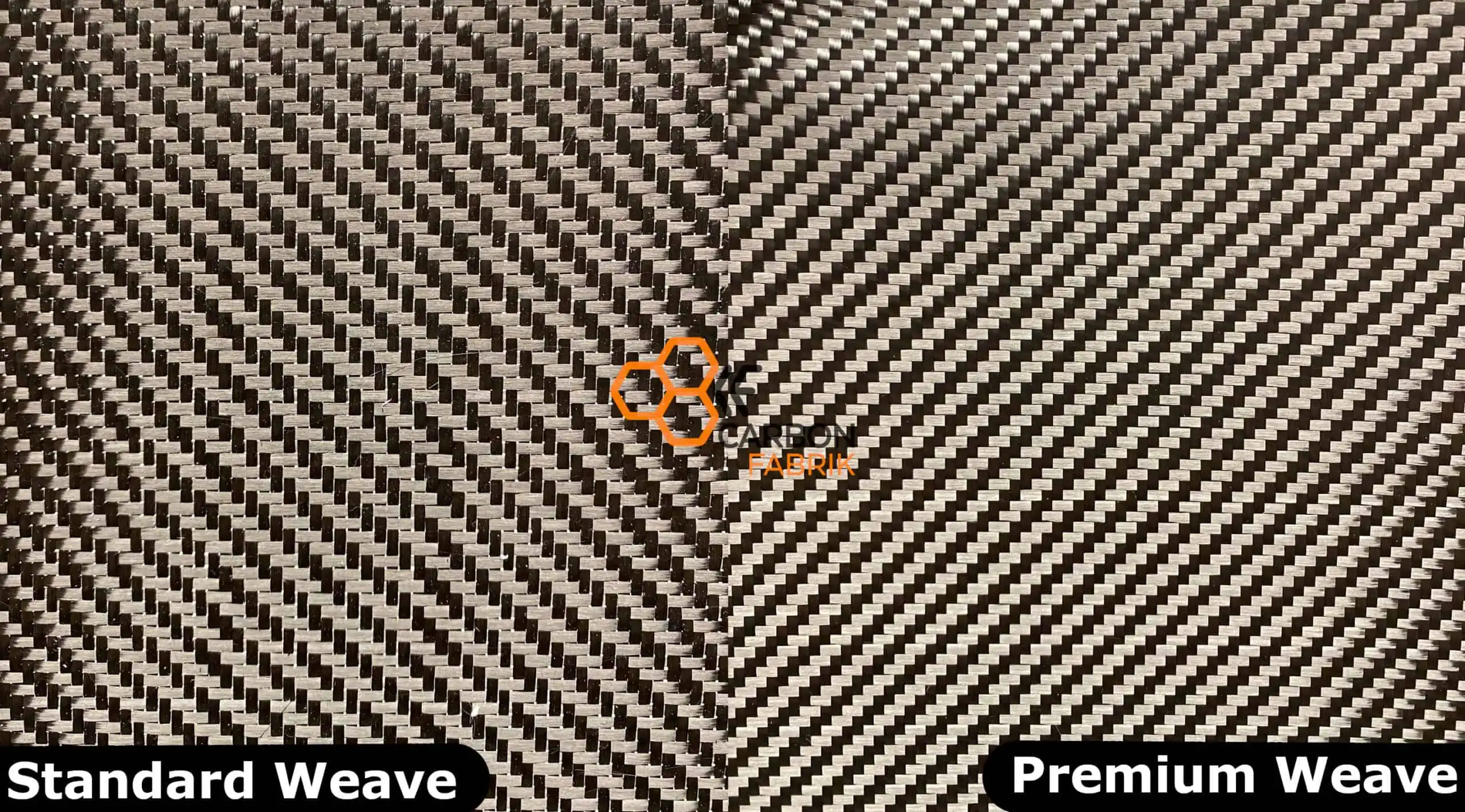
A dense weave ensures there are no gaps where the yarns cross and that the fabric looks the same everywhere. Cheap fabrics often show irregularities; good ones have an even, very dense weave without holes. High-quality 245 g twill is woven with 6 or more yarns per centimetre. Cheaper fabrics also claim 6 yarns/cm, but tend to sit at the lower tolerance of around 5.8 – which leaves visible gaps between the yarns.
Bottom line
Standard fabric is not spread, only “fairly” densely woven and made from a lower-grade yarn. This causes shading and uneven areas – tiny irregularities that carbon reacts to strongly in sunlight, and that become visible at night under street lights in particular. Premium fabric made from densely woven Toray yarn, by contrast, reacts evenly to light and looks considerably more refined overall.
2. Resin
There are two main types of resin: epoxy and polyester. Epoxy resins are mechanically stronger but more expensive and harder to process. We use a high-quality, temperature-resistant epoxy resin. It has a slight blue tint which, together with the premium fabric, gives our parts a cool look and – in addition to the clear coat – prevents yellowing. On top comes an epoxy gelcoat, the same kind used as the outermost layer on full carbon parts.
Post-curing
Post-curing is crucial. In the last of three curing cycles, our parts spend up to 20 hours at high temperature in the oven so that the epoxy fully cross-links and cures. That's the only way to get a result that lasts.
The problem with the substrate
With laminated parts, durability depends heavily on the original part underneath. Carbon has a negative coefficient of thermal expansion, whereas most plastics expand considerably when warm. This puts shear stress on the laminate. Our solution is the CF Premium System: instead of laminating plastic, we make a full carbon front and attach all the necessary mounts to it. This makes the parts much tougher and longer-lasting – and they look better.
Why not polyester?
Top coats can also be sprayed with polyester resin. The problem: polyester bonds poorly to epoxy and is brittle and yellowish. On top of that, the resin is heavily thickened (thixotropic) to speed up processing. These thickeners scatter light – the parts look yellowish and cloudy, especially at a shallow viewing angle. Combined with the expansion of the plastic parts, the brittleness quickly leads to cracks, particularly at sharp edges. Polyester saves a lot of work and makes parts cheaper and quicker to produce – at the expense of quality. That's why we only use epoxy resin. If you do it, do it right.


3. Preparation
Preparing the substrate and matching it to the material is hugely important for durability. Everyone has heard of carbon parts that come loose – why does that happen? Plastics in particular are hard to bond with resin, because the resin does not etch the surface. Aluminum isn't etched either, and a resin bond is not mechanically flexible: in summer, aluminum and carbon expand differently and shear forces can lift the coating. Bonding with resin also risks resin build-up and brush marks that later show up as shading.
Plastics
For plastics, a high-quality 2K industrial adhesive – as used by the OEMs – is the right choice. It works on almost any substrate except PE and PP. These low-surface-energy plastics are very hard to bond and also need an adhesion promoter.
Metals – almost always aluminum
The adhesive would hold directly on aluminum, but only mechanically. That's why, after sanding, we apply a primer that forms a chemical bond with the aluminum. Working quickly prevents aluminum oxide from forming in between. Only then is the industrial adhesive applied.
Result
- Every substrate gets the best possible bond.
- The surface under the fabric is smooth – the fabric stays free of shading.
- The bond stays flexible and absorbs shear forces.
We deliberately use high-quality – and therefore more expensive and demanding – materials, because that's the only way to meet our own standards. With CF Premium we go one step further. You'll find more of the basics in the article What is carbon?

 English
 German