
1. What is carbon?
Carbon is a fiber composite made of two main components: the carbon fibers and the matrix material, e.g. epoxy or polyester resin. The fibers are embedded in the matrix as woven or non-crimp fabric. Together, the material has better properties than either component alone: the fibers provide high tensile strength and stiffness, while the matrix keeps them in place and protects them from the environment.
Carbon stands out for its very low density, excellent mechanical and chemical properties and its unique look. The fibers are anisotropic – they only really take loads along the fiber direction. That's why woven and non-crimp fabrics are used to carry loads in several directions. It's no coincidence that VW calls carbon the material of the future.

Tip: Carbon is often wrongly called “carbon-reinforced plastic”. But the reinforcement comes from the fibers – not from the carbon itself, which is just as present in ordinary coal.
2. What are carbon fibers?
Carbon fibers (filaments) have a diameter of about 5–9 µm and consist of chains of carbon atoms. They are made by pyrolysis of a carbon-containing precursor such as polyacrylonitrile (PAN) or pitch: put simply, heat drives off every element except carbon as gas. At 1,300–1,500 °C the carbon content reaches 96–98 %. Tension applied during the heat treatment aligns the carbon atoms and thus sets the fiber direction.
“A material in fiber form is many times stronger than the same material in bulk form – and the thinner the fiber, the greater its strength.”A. A. Griffith, quoted in Ehrenstein, 2006
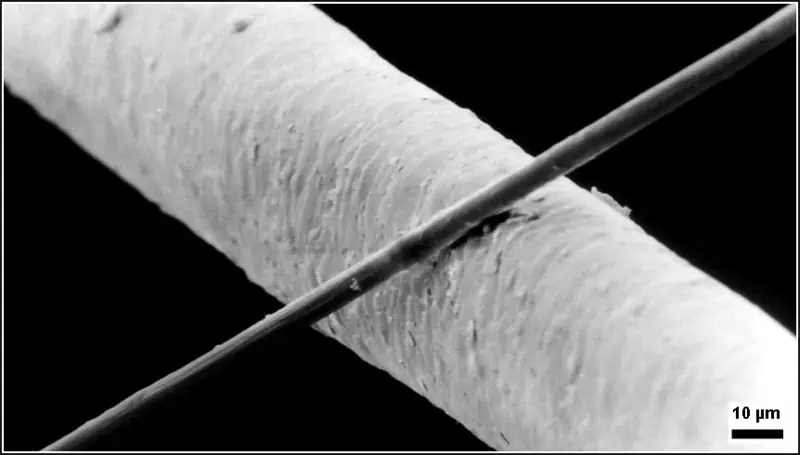
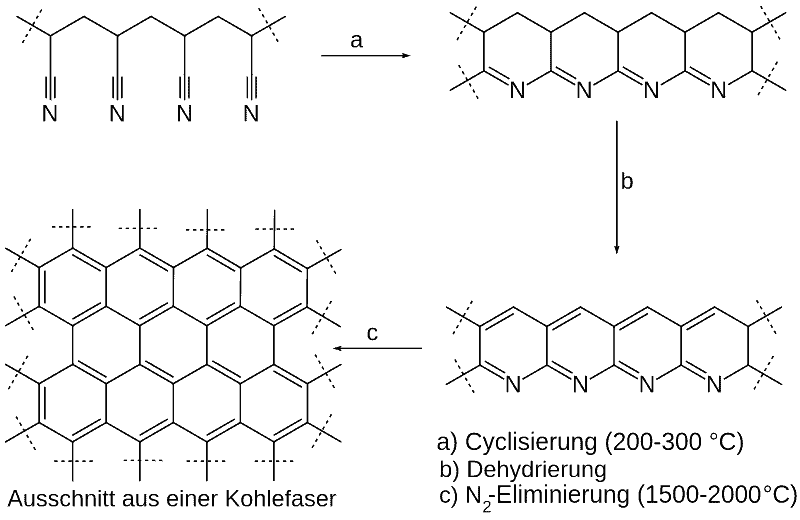
Carbon fibers conduct electricity and heat very well. Their Young's modulus – the ratio of stress to elastic strain – is 240 GPa along the fiber for HT fibers, far above aluminum at 70 GPa. That means high stiffness. Across the fiber, the modulus is about 11 times lower. Aluminum and steel, by contrast, are isotropic and behave the same in every direction.
Tensile strength is around 3.5 GPa. If it is exceeded, the material fails – and carbon splinters badly. Combining it with aramid or a foam core reduces this. To make use of the fibers' properties, they must be aligned with every direction of load.
Fiber classes
Depending on process and temperature, fibers differ greatly:
- HT – High Tenacity
- UHT – Ultra High Tenacity
- LM – Low Modulus
- IM – Intermediate Modulus
- HM – High Modulus
- UM – Ultra Modulus
- UHM – Ultra High Modulus
- UMS – Ultra Modulus Strength
- HMS – High Modulus / High Strain
3. What are woven and non-crimp fabrics?
A single fiber is useless for technical applications – the properties have to be achieved over a large area. That's why fibers are bundled into rovings (tows). The number of filaments per roving is given in K: 1K = 1,000, 3K = 3,000, 6K = 6,000 filaments.
Since hardly any component is loaded in one direction only, rovings are combined into woven or non-crimp fabrics. Think of it this way: a fishing line only takes loads lengthwise, a fishing net takes them lengthwise and crosswise.
Woven fabrics
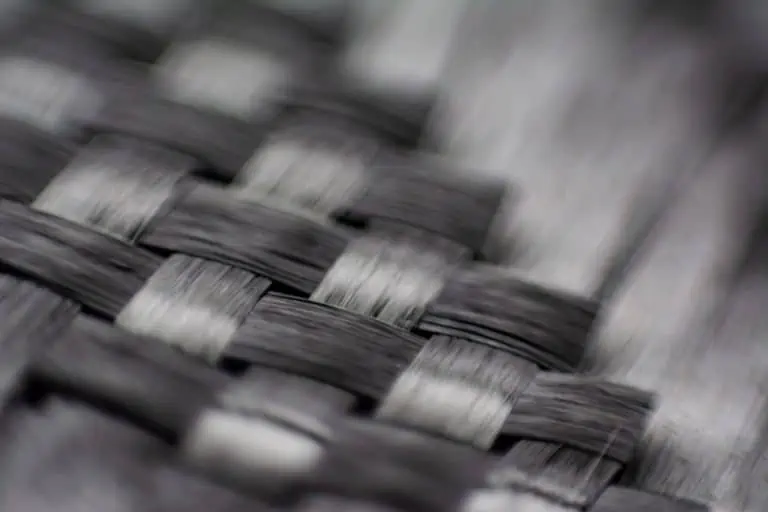
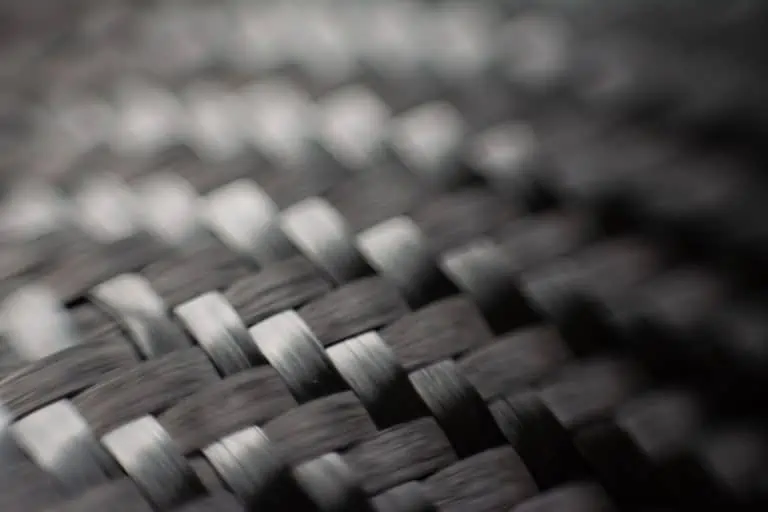
Woven fabrics are rovings interlaced with each other. The lengthwise ones are called the “warp”, the crosswise ones the “weft”. The weave determines the properties – the main types are plain, twill and satin weave.
Plain weave
The simplest weave: the weft yarn runs alternately over and under one warp yarn – recognizable by the checkerboard pattern on both sides. The tight interlacing prevents the fibers from shifting, but it drapes poorly and is hardly suitable for three-dimensional shapes.
Twill weave
Probably the most common fabric in the car industry: the weft passes over at least two warp yarns, creating the typical diagonal pattern. Twill drapes well and can be used for strongly three-dimensional parts – but it needs care so the rovings don't shift.
Non-crimp fabrics
Unidirectional fabrics (UD) consist of parallel fibers and, like rovings, are strongly direction-dependent. Bidirectional fabrics have two layers at 0/90° or ±45° (biaxial) and suit torsional loads, for example in a drive shaft. Triaxial and quadriaxial fabrics have three or four fiber directions.
Calculating areal weight
A 3K roving (200 tex = 0.2 g/m) is about 0.2 cm wide – so a 2×2 twill fits around 5 rovings per cm in each direction. Per square meter that's 500 rovings per direction, i.e. 100 g. Warp plus weft gives an areal weight of 200 g/m². Higher areal weights mean larger rovings and a coarser pattern.
- Fibers are bundled into rovings, specified in filaments per roving (e.g. 3K).
- Roving weight is given in tex (g per 1,000 m).
- Woven and non-crimp fabrics take loads in several directions.
- The higher the areal weight, the coarser the weave pattern.
4. What is a matrix material?
The matrix protects the fibers from the environment and, above all, stops the fabric from shifting. Epoxy resins are mixed with a hardener in a fixed ratio and cure by polyaddition into a thermoset – a plastic that can no longer be reshaped. They are resistant to heat and chemicals, mechanically strong and shrink by only 0.5–5 %. The reaction does, however, generate a lot of heat.
Polyester resins are cheaper and easier to work with, but they smell strongly, are mechanically weaker, shrink more and bond poorly to metal. Unsaturated polyester resins are mainly used for GFRP, because their styrene dissolves the binder in glass fiber mats.
5. What types of carbon parts are there?
Full carbon
The component is made entirely from carbon. Woven and non-crimp fabrics are combined in a female mold, with a core material depending on the application. Doubling the material thickness gives eight times the area moment of inertia and four times the section modulus – important for a roof, for example. Processes such as vacuum infusion or prepreg ensure few defects and a high fiber content. Full carbon offers minimal weight with the best mechanical properties. Our CF Premium parts are made this way too.
Visible carbon
For many car parts, weight saving doesn't matter – a full carbon mirror cap is hardly lighter than a coated plastic one. Here, the part is covered with the same fabric that forms the visible side of a full carbon part. No film, no hydro dipping: with good workmanship, the look is very similar. More on this under carbon coating.
Genuine carbon
An everyday term: it simply means real carbon was used – as full or visible carbon. It excludes carbon-look film, hydro dipping and fiber imitations, which you can spot by their lack of depth.
6. How are carbon fibers processed?
Hand lay-up
Typical for coating: the part is sanded and primed to suit the substrate. The fabric is then draped by hand, wetted out with resin and de-aired. Once cured, it is sanded smooth – repeatedly, until the matt surface shows an even tone without damaging the fibers. Finally, a suitable clear coat protects against UV light and scratches.
Vacuum infusion
A process for full carbon parts using a female mold. Fabrics and core are laid in and fixed with spray adhesive, then covered with peel ply and films that absorb excess resin and guide the resin flow. The air is evacuated under the vacuum bag and the resin is drawn in through a hose; atmospheric pressure pushes it through the entire part. After about 24 hours the part is hard and can be post-cured.
Prepregs
Prepregs are fabrics pre-impregnated by the manufacturer with a precisely dosed amount of resin and protected by release films. The resin stays dormant at low temperature and is only activated by heat and pressure – so prepregs must be stored refrigerated. After lay-up and evacuation, they cure under high pressure and temperature in an autoclave. This produces full carbon parts of consistently high quality. Wet prepregs work in a similar way, except that dry fabric is impregnated with an exactly calculated amount of resin and is not cured in an autoclave.
Conclusion
Carbon is a high-tech, strong, stiff, chemically resistant and lightweight fiber composite made of carbon fibers and a matrix. Because the fibers are anisotropic, they are combined in woven and non-crimp fabrics – their orientation determines the properties of the finished part. The resin protects the fibers and cures into a thermoset.
Further reading: Wikipedia: Carbon fiber (German), Wikipedia: Carbon fiber reinforced plastic (German) and the R&G Wiki. Questions or suggestions? Email us at info@carbonfabrik.com. Also worth reading: 4 reasons for carbon finishing with genuine carbon.
FAQ
What is carbon?
Carbon is a strong, stiff, chemically resistant, lightweight and versatile fiber composite made of carbon fibers and a matrix. The fibers are anisotropic, so they are combined with the matrix as woven or non-crimp fabrics to carry loads in several directions and to stop the fibers from shifting.
Laminating carbon – which adhesive?
Spray adhesive is ideal for fixing the fabric: apply thinly, lay the fabric on and press lightly – nothing slips. For the actual carbon finishing, industrial adhesives are used.
How do you cut carbon fabric?
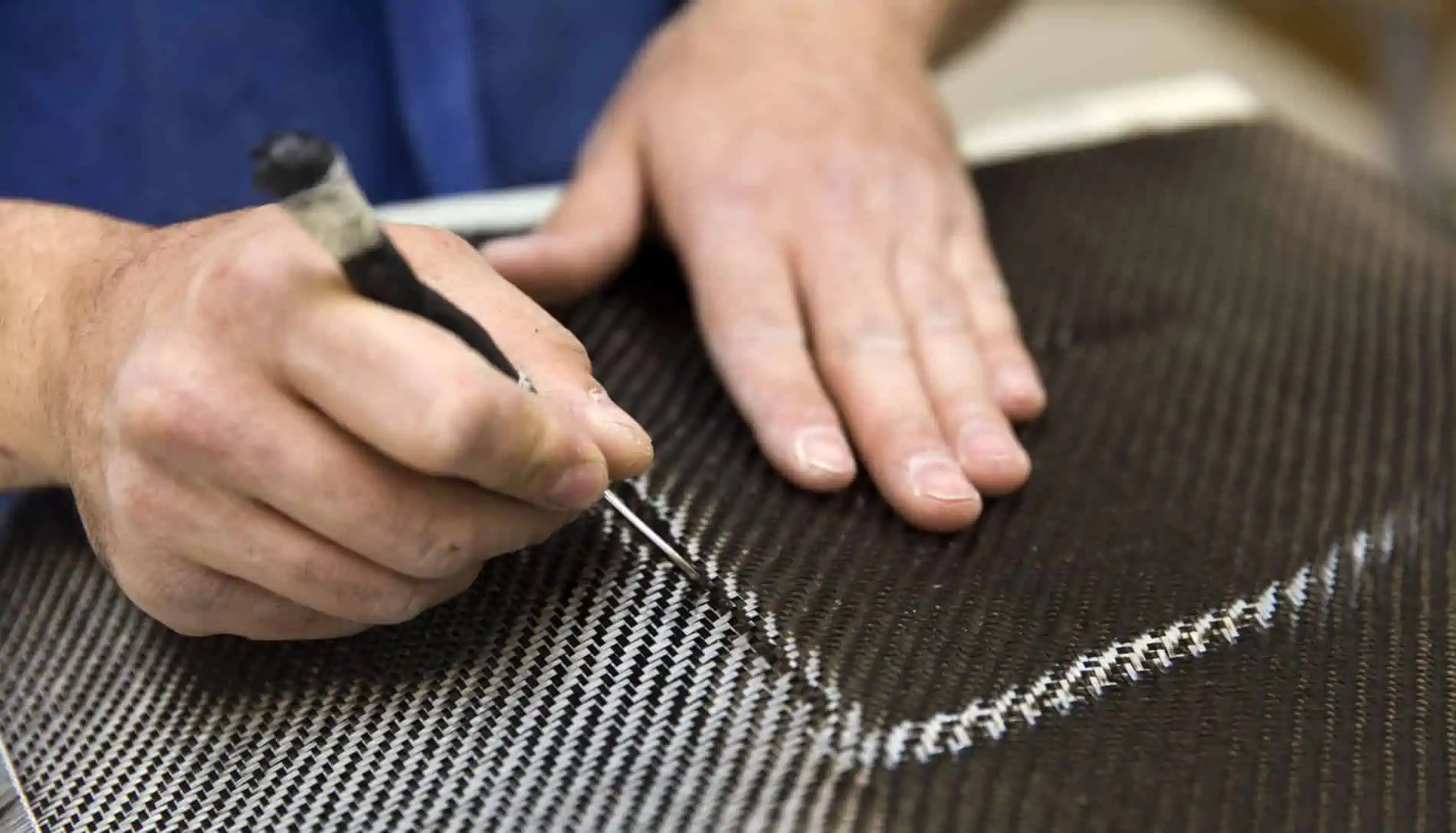
Dry fabric can be cut with ordinary household scissors. Pulling out two weft yarns first leaves a visible line to cut along. Cured carbon can be worked with an angle grinder, Dremel or drill – always wear a respirator and safety glasses.
How are molded carbon parts made?
Full carbon parts need a female mold of the original. It is polished and treated with release agent. Then the fabrics are laid in (the first layer is the visible side) and the resin is introduced by vacuum infusion. Alternatively there are out-of-autoclave prepregs that cure in an oven – but at around €60–70/m² they are considerably more expensive. Coating, on the other hand, is done by hand lay-up. More on this
Twill or plain weave?
For coating, twill is usually easier because it drapes better – even over three-dimensional shapes. For flat parts, plain weave works too. Full carbon parts combine different layers, e.g. 2×2 twill for the visible layers plus core and non-crimp fabric for stability. More on this
Carbon vs. carbon fiber – what's the difference?
Carbon (CFRP) is the finished product made of carbon fibers and a matrix (epoxy or polyester resin). Carbon fibers are the raw material, processed in rovings into woven or non-crimp fabrics.
How much does it cost to have carbon parts made?
Full carbon is expensive because every component needs its own female mold. For large parts such as a roof, costs quickly run into four figures. The much cheaper alternative is carbon coating: for a set of coated mirror caps, expect around €250–500 depending on the work involved.
How environmentally friendly is carbon?
Production needs a lot of energy, and recycling is difficult because the fibers can't easily be separated from the matrix. Like other plastics, carbon is also hardly biodegradable.

 English
 German